Tour de France 2026: GC Favourites
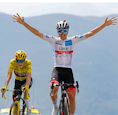 fotobureau Cor VosTadej Pogacar is the best rider of his generation and possibly the greatest of all time. Yet Jonas Vingegaard has already got the better of him twice in the Tour de France. Who will come out on top this time?
First published on 26 June 2026
Tadej Pogacar won the Tour de France in 2020, 2021, 2024 and 2025. In the two editions in between, Jonas Vingegaard came out on top. On both occasions, outstanding teamwork played a key role, but the Dane also prevailed because he is an exceptional rider in his own right. He may lack the swagger and flamboyance of the Slovenian, yet that is probably where his strength lies: simply doing what he does best, backed by a team that is as strong as it is tactically astute.
The recent Giro d'Italia illustrated that perfectly. Vingegaard was by far the strongest rider in the race, but he was also supported by the strongest team. Vingegaard and Visma | Lease a Bike bring out the best in one another.
Pogacar chasing fifth Tour title
While teamwork has long been Visma | Lease a Bike's greatest strength, it has often been the Achilles' heel of Pogačar's team, UAE Team Emirates–XRG. There has never been a shortage of outstanding riders, but they have not always been willing to sacrifice their own ambitions for the greater good. Juan Ayuso was the clearest example, showing little appetite for working in support of Pogacar.
This year's designated super-domestique, Isaac del Toro, is cut from a different cloth. Having already won the UAE Tour, Tirreno–Adriatico and, most recently, the Tour Auvergne–Rhône–Alpes this season, the Mexican is eager to support Pogacar in his bid for a fifth Tour de France title. Should he succeed, the world champion would draw level with Jacques Anquetil, Eddy Merckx, Bernard Hinault and Miguel Induráin on five overall victories.
Seixas takes on established order
Paul Seixas is the new kid on the block when it comes to Grand Tours. Still only 19, he has already made quite an impression this season, most notably with a Pogacar-esque one-man show at the Tour of the Basque Country. The expectation had been that he would battle Isaac del Toro and Juan Ayuso for the overall victory, but both abandoned the race early, leaving the Frenchman to run riot. He won all the classifications and three of the six stages.
That eagerly anticipated showdown between the three young talents was due to be renewed at the recent Tour Auvergne–Rhône–Alpes, but once again it never materialised. This time, Seixas crashed during the final weekend. We will therefore have to wait until the Tour de France to see how he measures up against the established stars of the peloton.
Red Bull–BORA–hansgrohe with two cards to play
Looping back to the power of teamwork, this could also prove to be a major asset for Red Bull–BORA–hansgrohe. With Remco Evenepoel and Florian Lipowitz, the German outfit has two dark horses for the overall victory, and if they work well together, the whole could be greater than the sum of its parts. Lipowitz was the only rider able to offer Seixas any resistance in the Tour of the Basque Country, while he also emerged as the best of the rest behind Pogacar at the Tour de Romandie. And Evenepoel is, well, Evenepoel: a world-class rider with a phenomenal time trial, but one who has yet to fully live up to expectations in the Grand Tours.
He has won one – the 2022 Vuelta a España – but that was four years ago. Since then, Vingegaard has completed the set by winning all three Grand Tours, including cycling's biggest prize twice. And then there is Pogacar, with four Tour de France titles and a Giro d'Italia victory to his name.
One final thought on teamwork. It is all very well having the numbers, but if Pogacar launches one of his trademark long-range attacks and turns the race into a straight duel, every tactical plan goes out of the window.
The road to the Tour
Pogacar opted for an unusual build-up this spring. He rode just two stage races – the Tour de Romandie and the Tour de Suisse, winning both comfortably – while also dominating the Classics. Victories in Strade Bianche, Milan–San Remo, the Tour of Flanders and Liège–Bastogne–Liège underline that he is one of a rare breed of riders capable of excelling in both one-day races and stage races.
Vingegaard lined up in three races this spring and won every single one in convincing fashion. He claimed overall victory in Paris–Nice and the Volta a Catalunya, collecting two stage wins in each, before adding the Giro d'Italia to his palmarès with no fewer than five stage victories. In recent years, the pattern has been remarkably simple: whenever the Dane starts a race, he wins it – unless Pogacar is on the start line as well.
Seixas opened his season at the Volta ao Algarve in February, where he had to settle for second behind Ayuso. As mentioned earlier, he then ran riot at the Tour of the Basque Country. The Tour Auvergne–Rhône–Alpes, however, ended in disappointment after a crash forced him to abandon the race.
Evenepoel also made an excellent start to the season, winning the Volta a la Comunitat Valenciana, the Trofeo Serra de Tramuntana and the Trofeo Andratx–Pollença. His challenge at the UAE Tour, however, ended in disappointment, as he struggled in the mountains. The same happened, albeit to a lesser extent, at the Volta a Catalunya, where he finished fifth. He bounced back in style at the Tour of Flanders, finishing third on his debut behind Pogacar and Van der Poel.
Third in last year's Tour de France, Lipowitz is still waiting for his first victory of the season, although consistency has never been an issue. He has finished runner-up twice – at the Tour of the Basque Country and the Volta a Catalunya – and third once. His only weakness may be that he is sometimes a little too reserved. A touch of his team-mate Evenepoel's swagger would not go amiss.
Ayuso, by contrast, is certainly not short of confidence. Unwilling to ride in support of Pogacar, he moved to Lidl–Trek this season. He hit the ground running by beating Seixas at the Volta ao Algarve. He then made an excellent start to Paris–Nice, only to crash out while leading the overall classification. Physical problems also forced him out of the Tour of the Basque Country. It was not until the recent Tour Auvergne–Rhône–Alpes that he returned to form, although he ultimately had to concede overall victory to Del Toro.
In conclusion: who is the Tour favourite?
There is little doubt that Pogačar stands head and shoulders above the rest of the current peloton. The same can almost be said of Vingegaard. Behind those two, however, an intriguing battle for the final place on the podium is shaping up. With Seixas, Evenepoel, Ayuso, Lipowitz and perhaps one or two surprise contenders, the fight promises to be a fascinating one.
Seixas remains something of an unknown quantity. It seems only a matter of time before he is capable of challenging Pogačar and Vingegaard on equal terms. Whether that moment has already arrived is one of the questions the coming weeks will answer.
GC Favourites 2026 Tour de France
***** Tadej Pogacar
**** Jonas Vingegaard
*** Paul Seixas, Florian Lipowitz, Juan Ayuso
** Remco Evenepoel, Isaac del Toro, Lenny Martinez
* Richard Carapaz, Mattias Skjelmose, Cian Uijtdebroeks
Key stages
[Click the italic links for detailed stage descriptions]
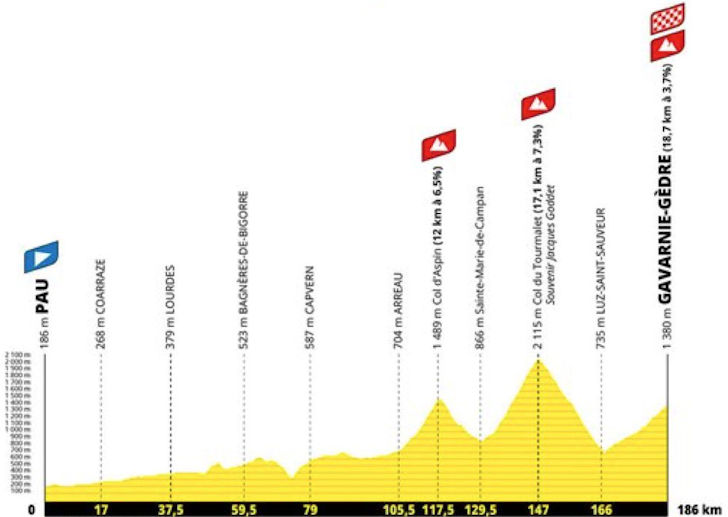
Stage 6: Pau-Gavarnie-Cèdre - 186.2 kilometres with 4,100 metres of elevation gain, summit finish, final climb of 18.7 kilometres at 3.7%.
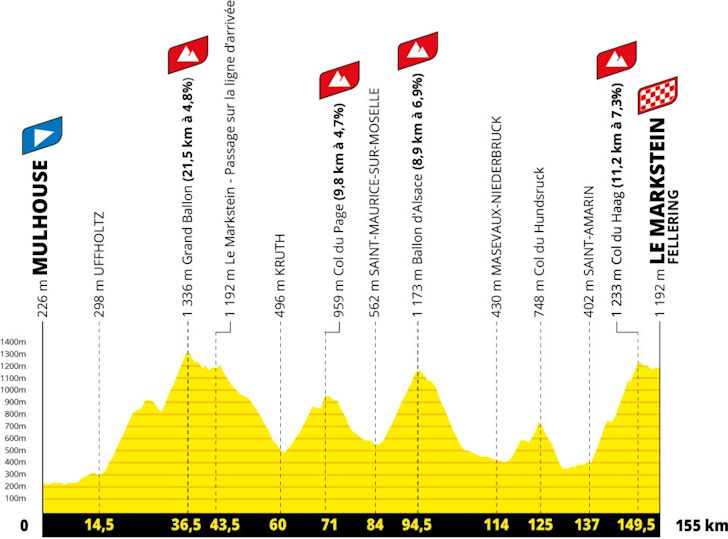
Stage 14: Mulhouse-Le Markstein - 155.3 kilometres with 3,800 metres of elevation gain, no summit finish.
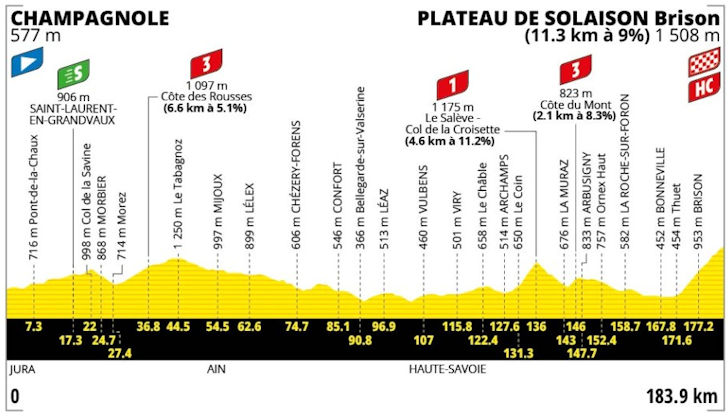
Stage 15: Champagnole-Plateau de Solaison - 183.9 kilometres with 3,950 metres of elevation gain, summit finish, final climb of 11.3 kilometres at 9%.
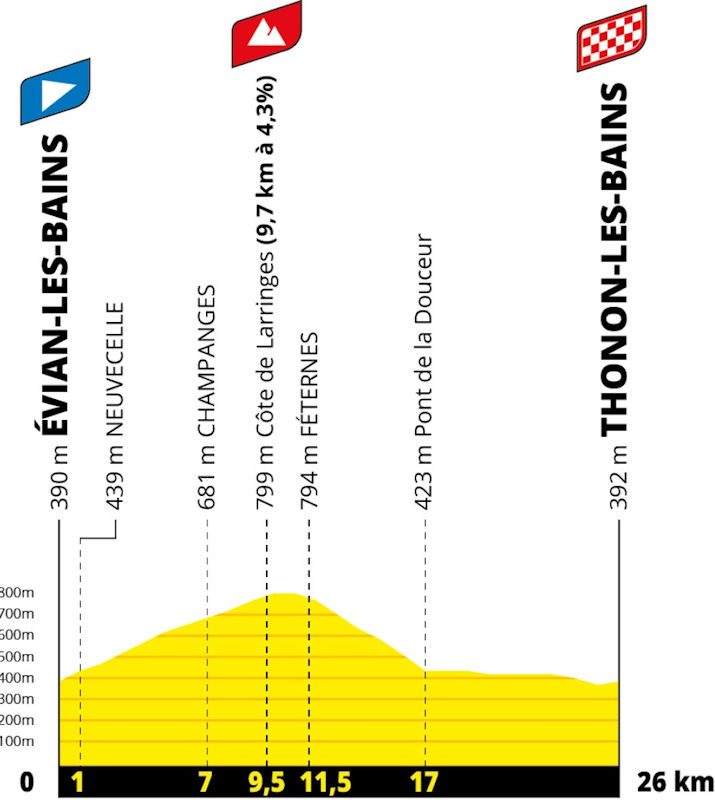
Stage 16: Evian-les-Bains-Thonon-les-Bains - 26.1 kilometres with 500 metres of elevation gain, individual time trial.
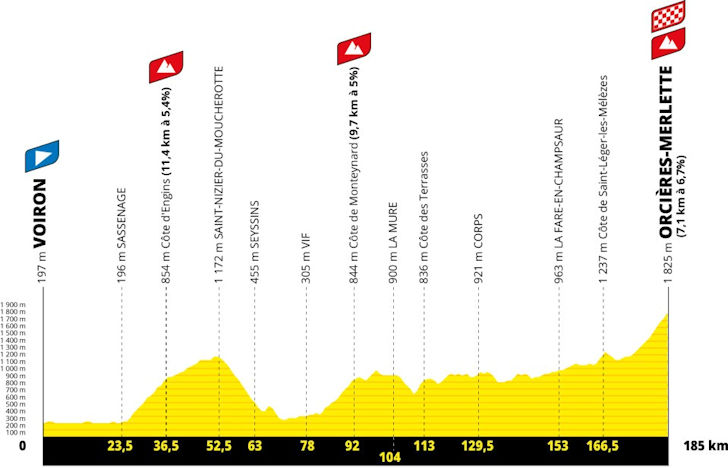
Stage 18: Voiron-Orcières-Merlette - 185.2 kilometres with 3,900 metres of elevation gain, summit finish, final climb of 7.1 kilometres at 6.7%.
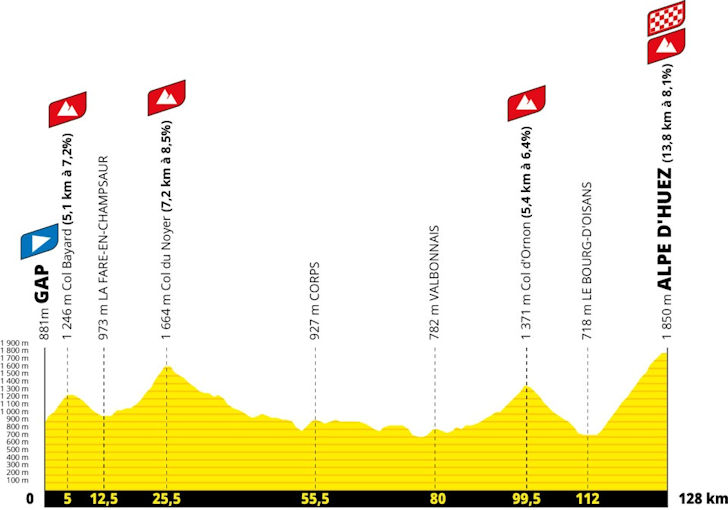
Stage 19: Gap-Alpe d'Huez - 127.9 kilometres with 3,500 metres of elevation gain, summit finish, final climb of 13.8 kilometres at 8.1%.
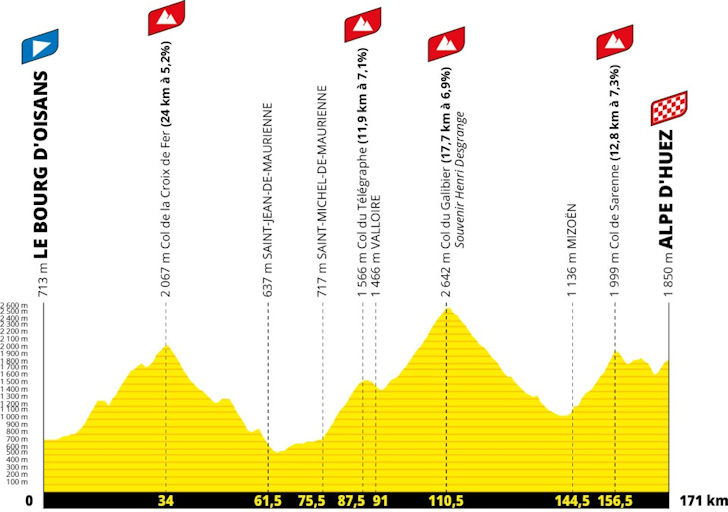
Stage 20: Bourg d'Oissans-Alpe d'Huez - 170.9 kilometres with 5,450 metres of elevation gain, summit finish, final climb of 3.7 kilometres at 6.2%.
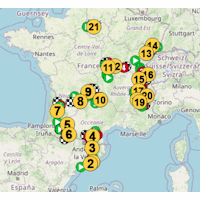
Tour de France 2026: full route & key stages' profiles
Click the images to enlarge
Comment
No comments yet, please share your view!